How to Stop Binge Eating
How to Stop Binge Eating
If you are reading this after a hard night, or in the quiet that comes after a binge, I want you to know that you are not alone. I have sat with so many clients who described that same feeling, the deep exhaustion of making the same private promise over and over and watching it slip away again. I have sat with clients who carried this for years before they ever said the word “binge” out loud to anyone, certain that the problem must somehow be them. I want to say plainly, to you, that binge eating is not a failure of willpower, and it is not a sign that something is wrong with who you are. Binge eating responds to understanding, gentle work, and the right kind of support. Over time with these solid things in place, it can genuinely start to shift. This guide is here to help you make sense of what you have been living with, and to point toward what actually helps.

What Binge Eating Actually Is
It can help to start with what binge eating actually is, because the word gets used in a lot of different ways, and that can leave you unsure whether what you are experiencing counts (spoiler, all experiences count). Clinically, a binge involves eating an amount of food that feels large in a relatively short window of time, along with a feeling of being unable to stop even if you want to. The defining piece is not really the amount, although that is often what people focus on. The defining piece is that loss-of-control feeling, the sense that you have left the driver’s seat of your own eating and body.
Occasional overeating is a normal part of being human. A holiday meal, a celebration, an evening when you eat more than you planned, none of that is the same as a binge. Binge eating becomes something more serious when it happens regularly, when it brings real distress, and when it starts shaping your life around it.
Binge eating disorder, often shortened to BED, is the diagnostic name for when binges recur regularly and cause significant distress, without the regular compensating behaviors that show up in bulimia, like purges, laxative use, restriction or overexercise. BED is the most common eating disorder, more common than anorexia and bulimia together, and yet it is often the least talked about and has the most shame around. You might have spent years quietly assuming your experience did not “count” because it did not look like the eating disorders you had heard about. If that is something you have wondered, please take this as your reminder that what you are experiencing matters and deserves real attention.
Why Willpower Isn’t the Problem (and Why Diets Make It Worse)
If there is one thing I most want you to take from this guide, it is this: Binge eating is not a failure of discipline or your fault. I have lost count of the number of times someone has come into my office, certain that what they need is to try harder, to be stricter with themselves, to finally find the right plan that gives them control. The painful truth, and also the hopeful one, is that this is almost never the answer. In fact, it is usually part of the problem. Searching and searching for a stricter solution brings more tension and stress to your relationship with food, rather than trust and ease which are needed to finally feel free.
The single biggest driver of binge eating is restriction, in both its physical and its mental forms. I know this can be really hard to hear, take a minute to center yourself before reading on. Physical restriction means not eating enough across the day, skipping meals, cutting out whole categories of food, or leaving long stretches of time between meals. Mental restriction is the food rules running quietly in the background, the labels of “good” and “bad,” the guilt that arrives with certain foods, the constant low-level negotiation with yourself about what you are allowed to have. When the body and the mind feel deprived, they eventually push back, and that can look like a binge or what many feel as a loss of control with food.
This is also why dieting, in whatever form it takes, is so rarely the solution it promises to be. Most of the people I see have been on some version of a diet for years, watching it work for a while and then collapse into a binge, and then feeling personally responsible for the collapse. The diet was not designed to last, and the binge that followed was not a moral failure, it was a predictable response from a body and brain to the mental and physical forms of starvation.
This is not a weight loss guide, and it will not become one. If restriction is what drives binges, then the way forward involves less restriction, more steadiness, and a great deal more self-compassion than most of us have been taught to give ourselves around food.
The Binge Cycle: How It Keeps Itself Going
It can be useful to picture binge eating not as a single behavior but as a loop, because once you see the shape of the loop, you can also see the places where it might be interrupted.
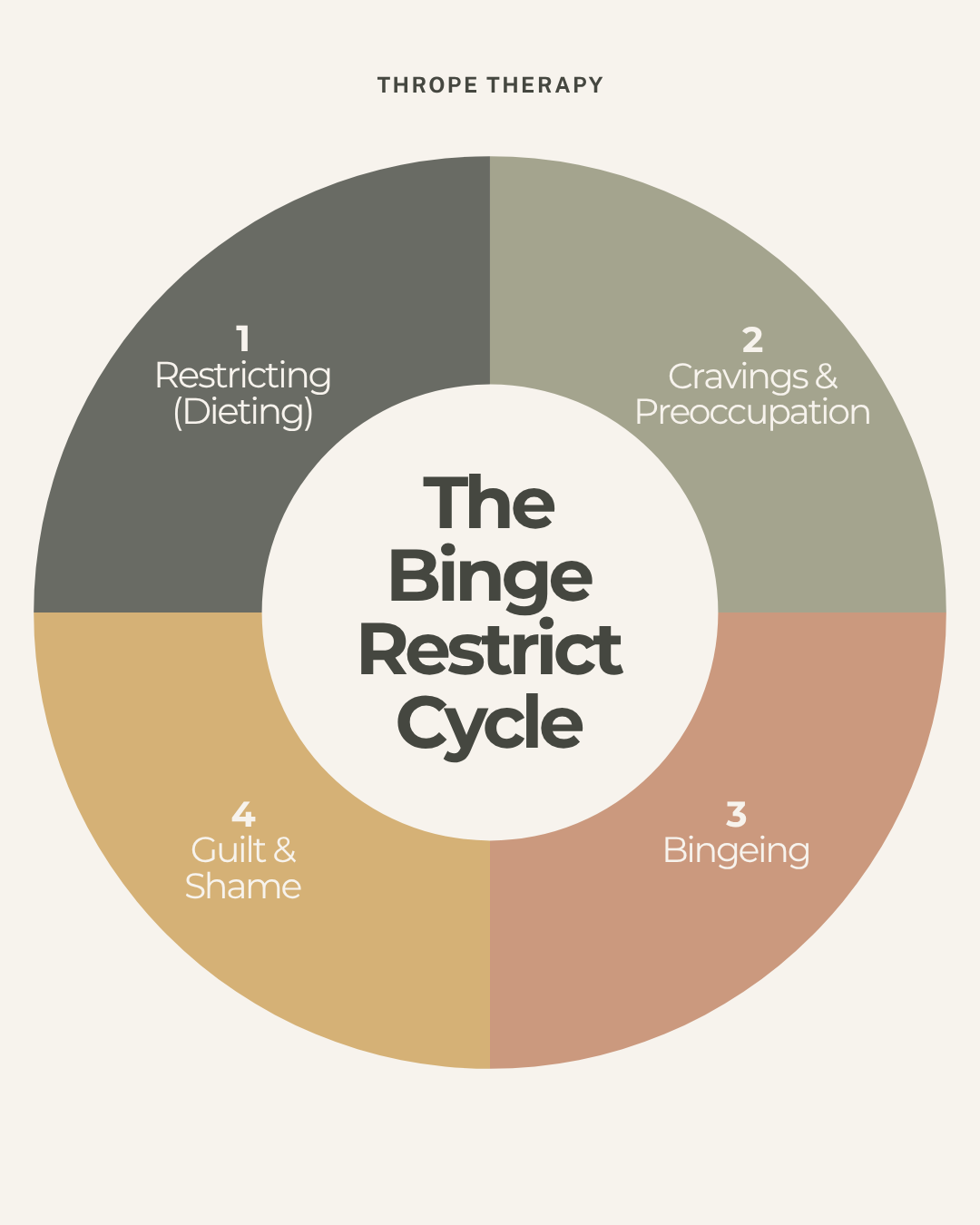
It usually begins with some form of pressure building up, whether that is physical (a body that is genuinely undernourished from the day), emotional (a hard conversation, a stressful afternoon, a wave of sadness), or both at the same time. The urge to binge arrives, the binge happens, and afterward, shame and guilt come in, often quite intensely, and they tend to bring with them a new resolve to be stricter starting tomorrow. That stricter resolve becomes the next round of restriction, which builds the next round of pressure, and the loop continues.
What is important about seeing the loop is that it is not a sign of weakness or of broken willpower. It is a self-perpetuating system, and once you can see it from a step back, you can begin to recognize when you are in it, and you can begin to consider what would happen if you stepped out at a different point than usual.
Binges, or usually any eating disorder behavior, are very often doing a job, or so they think they are. They are soothing an emotion that does not have another outlet, or they are providing a kind of numbing for feelings that are too big to sit with in the moment. Naming and noticing that, without judgment, is part of understanding what is actually going on, rather than just hating the behavior.
What Actually Helps
What follows is the kind of advice I find myself coming back to with clients again and again. I want to be clear before we dive in, that these are not rules to follow perfectly. Perfectionism is part of what fuels the cycle so we want to be mindful about attaching intensity and rigidity to this guide. The intention here is to give you some guidelines to lean into gently, not a new system to fail at.
Eat regularly and eat enough. This is the most counterintuitive piece, and also the most important. The single most reliable way to reduce binges is to nourish the body steadily across the day, eating roughly every three to four hours, including foods that actually satisfy you. Skipping meals, “saving up” for later, and waiting until you are very hungry to eat are all small forms of restriction that quietly load the system for the next binge. Many of my clients are surprised by how much shifts when they simply start eating more reliably, well before they are ever ravenous. I don’t want to gloss over how hard and vulnerable this step can be if you have relied on restrictions for a long time as part of your life. Working on restriction will be a really important step in working on reducing binge eating disorder.
Loosen the food rules. When a food is forbidden, the desire becomes louder and more persistent. The food you have told yourself you cannot have is often exactly the food that shows up in binges, because the deprivation gives it a charge it would not otherwise carry. Slowly making peace with foods that have been off limits is uncomfortable at first, and almost always worth it. Making peace with foods is one of my favorite parts of Intuitive Eating. Foods tend to lose their power when they are no longer kept on the other side of a wall. This takes mindfulness and a lot of intention to work on reducing the beliefs around food.
Get curious about your triggers. I do not mean a food diary used as a tool of control. I mean a gentle, non-judgmental practice of noticing what tends to come before a binge, meaning, what emotions come up, what sensations in the body, what temperature do you feel, what time of the day is it, how much sleep did you get? Many of the patterns that drive binges are easier to interrupt once you can see them clearly, but, they have to be allowed to show themselves first and you have to be specifically paying attention to them.
Build other ways to meet the feelings. If binges are doing the work of soothing or numbing something, the answer is not simply to remove the binge and leave you with nothing in its place. The answer is to start gently building other resources and skills that can help you manage big emotions as they come up. That can mean rest, connection, time outside, movement that feels good rather than punishing, creative outlets, or support from a therapist who understands what is going on. The goal is not to replace one thing with another exactly, but to widen the tools you have in your toolbox to take care of yourself when something hard is happening. Distress tolerance skills can be really useful here.
Urge Surfing and HALT. This is a simple but reliable check-in: am I Hungry, Angry, Lonely, or Tired? These four states amplify urges of all kinds, and they are easy to underestimate. Catching one of them early, and responding to the actual need first, often takes a great deal of pressure out of the moment. Urge surfing is a version of mindfulness that can help you visual yourself surfing the wave of the urge and reduce the impulsivity of a binge.
These are all strategies to practice slowly and with support. None of these work perfectly the first time, and none of them are a quick fix. What they do, slowly and gently, is start to change the cycle that has been creating the binges all along.

What to Do Right After a Binge
This is one of the most important small moments in the whole cycle, and it is the one we tend to focus on the least. The instinct after a binge is usually some form of compensation: skipping the next meal, eating very little tomorrow, planning a stricter regimen for Monday, or adding an extra workout to balance things out. The intention is to make up for what just happened. The trouble is that this is exactly what restarts the cycle. The compensation becomes the next round of restriction, which becomes the pressure that leads to the next binge.
So if you are reading this in the hours after a binge, the most useful thing you can do is the thing that probably feels the most counterintuitive. Do not skip your next meal. Eat something gentle and nourishing at the time you would normally eat. Treat your body with some basic care, water, rest, comfortable clothes, a little kindness. Notice with curiosity rather than condemnation what was happening in the hours before the binge. It is also ok to distance from the binge by distracting, doing something that is calming or reaching out for community support to reduce shame. Remind yourself, as many times as you need to, that what happens after a binge has more influence on the cycle than the binge itself. You don’t have to process it immediately and get to the root, but a bit of curiosity and kindness go a long way after a binge.
Binge Eating at Night
Nighttime is when a lot of binges happen, and there are good reasons for that. The day catches up with us in the evening, both physically and emotionally. If you have been under-eating during the day, your body is going to insist on what it needs once you finally slow down, and the kitchen is right there. If your day has been full of stress or social effort or holding yourself together, the evening is often when those held-together feelings start to surface, and food can be one of the only available outlets.
The first place I usually point people in this situation is the daytime, not the nighttime. Nighttime binges are almost always partly a daytime problem in disguise. Eating more reliably and more fully through the day, especially making sure you have eaten enough by mid-afternoon, takes a lot of the urgency out of the evening before the urgency ever has a chance to build.
From there, gentle evening structure can help. A wind-down routine, time away from screens, a warm shower, something to read, a short walk if it feels good, cuddling with pets or a partner. The goal is not to police yourself in the kitchen with rules, the goal is to take care of yourself in the hours when your body and your nervous system are at their most worn down.
When It’s Binge Eating Disorder, and When to Get Help
At some point along the way, it can be helpful to know whether what you are experiencing fits the clinical picture of binge eating disorder. BED is characterized by recurrent binges (typically at least once a week for several months), a clear sense of loss of control during those episodes, real distress around the experience, and an absence of regular compensatory behaviors like purging or extreme exercise. As I mentioned earlier, BED is the most common eating disorder, and a real, recognized, and treatable condition.
Treatment for BED is well established. Therapy is usually at the center of it, often using a form of cognitive behavioral therapy developed specifically for eating disorders and binge eating. The work tends to address the cycle itself, the restriction that fuels it, the patterns of thought around food and body, and the underlying emotions that the binges are often responding to. Many people also benefit from working with a dietitian, and for some, working with a psychiatrist to treat co-occurring anxiety or depression, which can be related to emotion regulation and eating patterns.
I want to say one thing very gently here. You do not need to wait until your situation feels “bad enough” to deserve support. There is no minimum level of struggle required to talk to someone. If food is taking up significant space in your thoughts, if your eating is causing you distress, if you have been quietly managing this for a long time, then that is enough to get started with support. Reaching out earlier can really help you navigate this challenge more quickly and effectively.
At Thrope Therapy our team of licensed mental health providers works with adults around binge eating and binge eating disorder in a way that puts you at the cente of the work. We know how much shame can sit underneath this work, and we take seriously the courage it takes to walk into a first session and say the word “binge” out loud. There is no rigid program here, and no plan you have to fit yourself into, because the patterns that have shaped binge eating in your life are particular to you.
We begin by getting to know you, what eating and binges have looked like, what you have already tried, and what you would like things to feel like instead. In our sessions we draw on CBT for binge eating, which is designed for this work, along with ACT, mindfulness and DBT to help with the anxiety, the emotions, and the gradual work of building a more flexible and compassionate relationship with food. We move at the pace you set, and the focus is on freedom and steadiness rather than control.
If Someone You Love Binge Eats
If you are reading this guide for someone else, your support can matter enormously, and a few small choices in how you respond will make a real difference.
What tends not to help, even when it comes from love, is commenting on what they eat or do not eat, what they weigh, or what their body looks like. Diet talk in the home, even casual diet talk that is not aimed at the person you love, lands harder than people realize. Trying to police what is in the kitchen, locking up food, or expressing disappointment after a binge all tend to add shame to something that is already entrenched in it.
What does help, much more often than it gets credit for, is steadiness. Keeping diet talk out of the house. Letting the person have safe and nourishing foods available without commentary. Being someone who is curious rather than fixing, and steady rather than alarmed. If they want to work toward getting professional help, supporting that without pressure, and without making it something that must happen on your timeline. Your presence as a consistent, calm and non-judgmental support is often the most powerful thing you can offer.

A Gentler Way Forward
If binge eating has slowly been making your world smaller, and your relationship with food more painful, I want you to know that it does not have to stay this way. Binge eating responds to the right kind of care, and the right kind of care is not stricter, it is steadier. It is not about finding more control, it is about removing some of the conditions that have created the binges and learning how to meet yourself with more kindness in the places where you have been hard on yourself for a very long time.
If you are wondering whether this might be a good moment to reach out for support, we would be glad to hear from you. At Thrope Therapy we work with adults around binge eating and the full range of eating disorders, and we offer both in-person sessions in Midtown Manhattan and virtual sessions across New York, Connecticut, and New Jersey, depending on what feels right for you. You can reach out through our contact page whenever you are ready. There is no need to have it all figured out before you do, and a first conversation is just a conversation. The relationship you have with food right now does not have to define how your relationship with food will be in the future.
Frequently Asked Questions
Why do I binge eat?
There is rarely just one reason, but the most common driver, by a wide margin, is restriction in some form. When the body and mind have been told no for too long, physically through skipped meals or strict rules, or emotionally through chronic dieting and food guilt, the system eventually pushes back. Binges are also often doing emotional work, meeting needs for soothing or numbing that have not been met any other way. There is a hunger hormone Grehlin which sends stronger signals of hunger if there is undernourishment throughout the day. This could be part of the biological aspect of a binge.
What causes binge eating?
Restriction, emotional triggers, and shame are usually the three forces working together. Restriction creates the pressure, emotional load creates the triggers, and shame creates the cycle that follows. Underneath all of that, factors like trauma history, anxiety, depression, and a lifetime of diet culture often play a role.
Is binge eating a disorder?
It can be. Occasional overeating is not the same thing as binge eating disorder. BED involves recurring binges, a clear sense of loss of control, real distress, and no regular compensatory behaviors. It is a recognized clinical diagnosis and the most common eating disorder.
How do I stop binge eating at night?
Almost always, by changing something during the day. Eating enough and consistently across the day, especially through the afternoon, takes most of the physiological pressure out of the evening. A gentle wind-down routine and care for your emotional load through the day also help. Trying to resist at night without addressing what is happening before is rarely the path that works.
What should I do after a binge?
Do not compensate. Skipping the next meal, cutting back tomorrow, or starting a stricter plan all restart the cycle. Return to normal eating at the next mealtime with as much gentleness as you can, take basic care of yourself, and get curious about what was happening in the hours and days leading up to it. Self-compassion after a binge is one of the most underrated interventions there is.
Will binge eating ever stop?
Yes. With the right support, people do recover. Recovery does not always mean that binges never happen again, but it does mean a relationship with food that is far less driven by cycles, restriction, and shame. Many of the adults I have worked with are genuinely surprised by how different things can feel once they have help that understands the dynamics underneath.
How do I know if I have binge eating disorder?
If binges are happening regularly, if there is a clear feeling of loss of control during them, and if they are causing real distress in your life, those are the central signs. Rather than self-diagnose from an article, the best next step is a conversation with a therapist who works with eating disorders. They can help you understand what is going on and what would help most.