I Ran My First Marathon! And Here’s What I Learned
I Ran My First Marathon! And Here’s What I Learned
Written by Lily Thrope
On January 11th, 2026, I became a first-time marathon finisher. Saying these words still feels surreal. So many moments leading up to the marathon felt like tests of my belief in myself. Why did I think I could do this? Why did I sign up? This last year was particularly difficult due to a couple of impactful medical conditions, and I wasn’t even sure it was safe for me to train at shorter distances, much less complete a full 26.2 miles.
As the race got closer, and everyone around me was hyped up about the holidays and New Year’s, it began to sink in that I was really doing this. I trained hard and stayed committed to a plan, but just as importantly, I nourished my body and took all the steps I could to prepare. That nourishment, physical, emotional, and mental, was not incidental. It was foundational.
Leading up to race day, I was a ball of anxiety. All the “what ifs” kept circling in my head. What if I can’t finish? What if I get swept from the course for not maintaining the required pace? What if I let myself or others down? What if I fail?
I had to accept that, on race day, whatever was meant to be would be and continue on with the belief that I could do it.
The morning of the race, I boarded the bus at 1:45 a.m. to head to Epcot at Walt Disney World. As I got ready that morning, something shifted. The nerves softened, and excitement began to take their place. I was about to attempt one of my life goals, in the happiest place on earth, surrounded by thousands of other runners.
The runDisney community is truly the most supportive and caring fitness community I have ever experienced. Much of my earlier relationship with fitness involved walking into NYC workout spaces and feeling the weight of competition and judgment. At runDisney, it’s customary to compliment costumes (YES, WE RUN IN COSTUME) and strategize about how to meet the most characters along the course, (photo breaks encouraged and celebrated).
This year brought added anxiety due to the heat, with race-day temperatures projected to reach an unseasonably warm 81 degrees. As I was adding salt to my water bottle, another runner asked if I could share. Of course I did. I knew, without question, that if the roles were reversed, someone would do the same for me. That sense of mutual care, of looking out for one another, made me feel safer and more grounded heading into the race.
At 4:57 a.m., I was off. I use a run/walk method, which has helped me maintain energy and stay injury-free. In the depths of my eating disorder, a voice would have said, “This isn’t really running if you don’t run the whole time.” My recovered self knows better. Honoring my body means listening to it, adapting, and choosing sustainability over rigidity.
My run/walk intervals are 4 minutes of running followed by 1 minute of walking so, yes, in the first five minutes of my 26.2 mile race I WALKED. And that’s OK!
The first 10 miles felt surprisingly smooth. I fueled every two miles with noogs gummies and stayed consistent. Long-distance fueling is critical, and being recovered from my eating disorder was essential in allowing me to follow through on this plan without fear, restriction, or second-guessing. My body needed fuel, and I trusted that need.
At mile 10, I ran through Cinderella’s Castle in Magic Kingdom, an unforgettable moment amplified by cheering crowds along Main Street U.S.A. After mile 11, I listened to voice notes from friends and family who had taken time to send encouragement. I teared up listening to their belief in me and it carried me through the long stretch of highway to Animal Kingdom.
Conquering the highway and finally reaching Animal Kingdom felt so special, and although I didn’t choose to ride Expedition Everest (did I mention you also have the option to jump on certain rides throughout the course?), it was very cool to run by the roller coaster and consider it. Maybe that’s a goal for next year :)
As I approached mile 20 and the temperature continued to rise, I made the decision to slow down further and adjust my intervals. I had maintained my pace for 20 miles, and I knew that easing up would help me finish safely and fully present.
When I later shared that I walked most of the final six miles, some people commented on how impressive it was that I could “set my ego aside.” The truth is, if I had run with ego in charge, I wouldn’t have finished at all. I was running as my own best friend, making decisions rooted in care, not punishment.
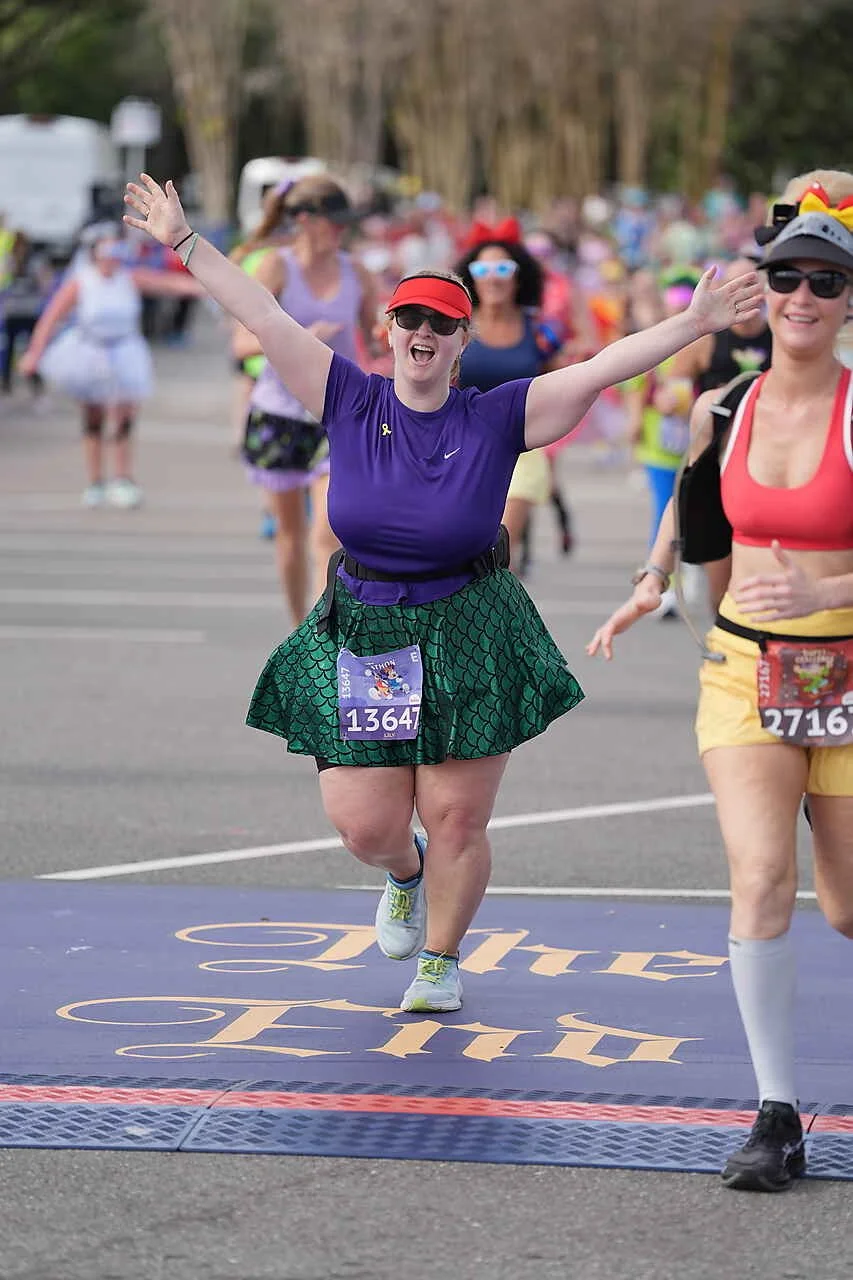
Crossing the finish line, I felt immense pride. The race felt both fleeting and monumental. Training for this marathon had become a lifeline during a year marked by disappointment and uncertainty, a steady reminder of what was possible when I showed up for myself consistently.
Some people noted that I didn’t look exhausted in my finish-line photo. I attribute that to fueling well in the days leading up to the race, eating consistently throughout, and honoring my body’s limits along the way.
There is a deeply ingrained belief, especially in diet culture and fitness spaces, that exercise only “counts” if it leaves us depleted. This marathon challenged that narrative for me in a profound way. Feeling strong, nourished, and supported after doing something hard is not a shortcut or a failure, it’s a sign of sustainability.
For those in eating disorder recovery, or those supporting it, this feels important to name: pushing yourself toward meaningful goals does not have to come at the expense of your wellbeing. Recovery makes room for effort and care, ambition and rest, challenge and safety. And sometimes, the most powerful finish line is choosing to treat your body with kindness along the way…or running a marathon at Walt Disney World.